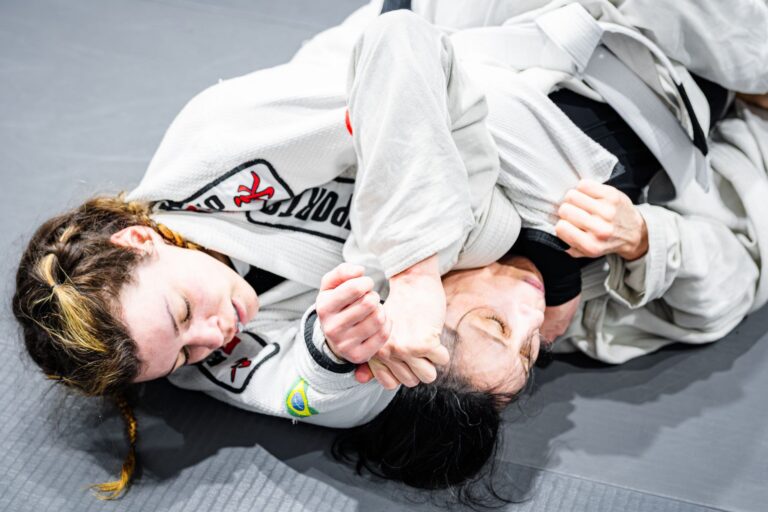
Yes, women absolutely can do BJJ, and it’s one of the safest combat sports available when trained properly. Brazilian Jiu-Jitsu is built on technique and leverage rather than raw strength, which means women of any fitness level can learn effective self-defense and build confidence on the mats. At Trein Club in Houston, our women’s classes are designed with proper progression, qualified instruction, and a supportive community that prioritizes safety over ego—meaning you’ll never be forced into uncomfortable positions or pressured to train beyond your comfort zone.
The safety of women in BJJ comes down to training environment and coaching quality. Unlike striking sports, grappling allows you to tap out instantly if something doesn’t feel right, giving you complete control over your intensity. Our instructors, led by 4x BJJ World Champion Pedro Araújo, emphasize technique-first training where beginners learn proper falling, positioning, and how to escape before ever rolling with a partner. Women train with women at beginner levels, building fundamentals in a judgment-free space where progress matters more than ego.
Beyond self-defense skills, female BJJ practitioners at Trein Club gain mental resilience, physical strength, and access to a thriving community of women at all levels—from complete beginners to competitive athletes preparing for IBJJF tournaments.
Can Women Do BJJ? Yes—And Here’s Why It’s Safe and Beneficial
Brazilian Jiu-Jitsu stands as one of the most empowering martial arts available to women, and it’s genuinely safe when practiced properly. Unlike striking-based combat sports that depend heavily on raw power, BJJ operates on principles of leverage, technique, and positioning. This fundamental difference means women of all sizes and fitness levels can train effectively alongside men, compete at elite levels, and develop authentic self-defense capabilities.
Over the past decade, participation among women has surged dramatically. From those taking their first class to female competitors claiming world championship titles, women demonstrate daily that this sport welcomes everyone. At Trein Club in Houston, our community reflects this reality—women train alongside men in an environment where progress takes priority over gender or physical size.
Is BJJ Safe for Women? What You Need to Know
Several factors determine safety in BJJ: qualified instruction, measured training intensity, thoughtful partner selection, and a culture that values technique over ego. When these elements align, BJJ proves remarkably safe. Research shows injury rates comparable to or lower than many recreational activities, including running and soccer.
Grappling’s controlled nature—where both participants maintain constant contact and can sense mounting pressure—creates fewer injury opportunities than striking sports with sudden impacts. Submissions allow practitioners to tap before damage occurs, and most serious injuries stem from poor form or reckless partners rather than the sport itself.
Safety Considerations for Female BJJ Practitioners
Women should understand specific anatomical factors when training. Chest compression during certain positions, pressure on breast tissue, and arm-based submission mechanics require open partner communication. Additionally, hormonal fluctuations can affect joint stability and injury susceptibility—some women notice their ligaments feel less stable at particular cycle points, which should influence training intensity choices.
Neck and spine protection matters equally for all practitioners. Correct technique in chokes, neck cranks, and spinal locks prevents serious harm. Qualified instructors teach proper positioning and ensure partners tap when pressure increases. Women should never feel obligated to endure submissions—tapping represents smart training, not weakness.
Hygiene standards directly impact everyone’s safety. Reputable academies maintain clean mats, require pre-training showers, and enforce strict skin infection protocols. This protects the entire community equally.
How to Minimize Injury Risk When Starting BJJ as a Woman
Begin gradually and maintain constant communication. Your initial month should emphasize fundamental positions and movements without aggressive intensity. Inform training partners you’re new, and request reduced pressure without hesitation. Most experienced grapplers respect this—they remember their own beginning.
Prioritize proper warm-up and recovery routines. Dedicate 10-15 minutes to dynamic stretching before class, then address foam rolling and mobility work afterward. This prepares joints and connective tissues for grappling’s demands. Supplementing BJJ with targeted strength and conditioning builds resilience—Trein Club offers specialized programs for this purpose.
Tap early and frequently. No reward exists for ignoring submissions. Tapping preserves your body for sustained training and demonstrates maturity. When partners tap, release immediately and completely. This mutual respect establishes a secure training environment.
Avoid training through injuries. Women sometimes face pressure to “push through,” but this compounds damage. If something hurts—especially joints—sit out or request technique modifications. Discuss alternatives with your instructor that keep you engaged without risking additional harm.
Why Women Should Train Brazilian Jiu Jitsu
Reasons women pursue BJJ extend far beyond self-defense, though that remains genuinely important. For many, it becomes a transformative practice that reshapes self-perception and understanding of personal capability.
Self-Defense Benefits of BJJ for Women
Most physical assaults occur at close range. BJJ trains practitioners to control opponents when distance collapses—precisely the scenario many women fear. Unlike striking martial arts, BJJ doesn’t require superior speed or strength. A woman with solid leverage and positioning knowledge can neutralize a larger attacker by controlling their limbs and base.
The sport teaches composure under pressure. During rolling, you’ll experience moments of positional disadvantage. Learning to breathe, think strategically, and escape from unfavorable positions directly translates to real-world composure during stressful situations. This mental training proves as valuable as physical techniques.
BJJ also develops spatial awareness and teaches recognition of danger signals. You learn to sense subtle pressure shifts and respond before situations escalate. This heightened body awareness extends beyond the training mat.
Physical and Mental Health Benefits for Female Practitioners
BJJ delivers a comprehensive full-body workout that builds functional strength without the joint stress of heavy weightlifting. Grappling engages your core, legs, shoulders, and back in integrated movement patterns that translate to practical strength. The physical benefits of training BJJ as an adult include enhanced cardiovascular health, increased muscular endurance, and improved body composition.
BJJ helps with weight loss through metabolic demands and lifestyle shifts that often accompany training. An intense rolling session burns 400-600 calories, and a supportive academy community encourages healthier overall choices.
Mentally, BJJ functions as moving meditation. The sport’s complexity demands complete presence—work concerns and relationship stress fade when someone attempts a submission. This mental reprieve, combined with achievement from learning techniques and advancing through belt levels, builds confidence while reducing anxiety and depression. Many women identify BJJ as their primary stress-management tool.
Building Confidence and Empowerment Through BJJ
Something remarkable happens when you discover capabilities you never imagined possible. A woman unable to perform a push-up learns to escape mount position. Someone fearful of confrontation learns to remain calm and problem-solve under pressure. This confidence radiates throughout life.
BJJ demystifies physical capability. You stop wondering “what if” and start understanding what you can accomplish. You’ve navigated uncomfortable positions and found solutions. You’ve faced challenges and persisted. This embodied knowledge transforms how you navigate the world.
Community amplifies this empowerment. Training alongside other committed women creates a support system extending beyond the mat. Academy friendships often become life’s most meaningful relationships because they’re built on mutual respect and shared challenge.
Can Women Excel in BJJ? Overcoming Size and Strength Differences
Absolutely. Women compete at the highest levels of BJJ globally, and many of the most technically skilled grapplers are female. The sport’s emphasis on leverage over strength means smaller, weaker opponents—whether women or smaller men—consistently defeat larger, stronger ones when they understand proper technique.
This isn’t theoretical. It happens daily in academies and on competition mats. A 120-pound woman with solid technique will submit a 200-pound untrained man. A female blue belt typically beats a male white belt regardless of size. Technique serves as the great equalizer in BJJ.
BJJ Techniques That Work for Smaller and Weaker Opponents
Certain techniques prove particularly effective for smaller athletes. Leg lock sequences require minimal upper body strength while controlling larger opponents through positional dominance. Arm drags use an opponent’s momentum against them. Collar chokes function through leverage rather than strength. Triangles, armbars, and omoplatas—fundamental submissions—don’t depend on size.
Footlock systems particularly benefit women because they neutralize size advantages. A woman understanding heel hooks, knee reaps, and ankle locks can control significantly larger opponents. Similarly, pressure passing and top control through proper weight distribution allow smaller athletes to dominate larger ones.
The most critical technical principle for smaller athletes involves controlling the centerline. When you control your opponent’s centerline—their spine and vital organs—their size becomes irrelevant. A woman who can break an opponent’s posture and control their spine applies devastating pressure regardless of strength differences.
Training Tips for Small Female BJJ Athletes
Embrace your size as an advantage. Smaller athletes move more fluidly, generate greater speed, and access positions larger athletes struggle with. A 130-pound woman can move in ways a 250-pound man simply cannot. Use this mobility to reach favorable positions before opponents realize what’s happening.
Develop leg lock expertise early. Invest extra time in footlock systems, knee reap entries, and heel hook mechanics. These techniques multiply force for smaller athletes. The investment pays dividends throughout your entire BJJ journey.
Master escapes obsessively. Smaller athletes spend more time in bottom positions, so become exceptional at escaping. Perfect bridge escapes, underhook escapes, and shrimp movements. When you can escape anything, you eliminate your opponent’s primary advantage.
Rely on timing and rhythm rather than strength. Feel when your opponent commits to a position, then move. Develop sensitivity to when pressure builds and respond before maximum force applies. This awareness becomes a superpower in BJJ.
Roll with partners of varying sizes intentionally. Training exclusively with similar-sized partners limits growth. Rolling with larger athletes forces technique refinement and problem-solving development. You’ll discover that size matters far less than anticipated.
Rolling with Larger Training Partners: Best Practices
Communicate your intentions beforehand. Before rolling with a significantly larger partner, briefly discuss intensity and goals. Explain whether you’re working on specific techniques or still learning. Most experienced grapplers adjust their approach accordingly.
Control the pace yourself. Don’t allow a larger partner to dictate speed. Move at your rhythm, breathe, and think. If they’re moving too fast, slow down and make them work to maintain speed. Larger athletes often depend on explosiveness—neutralize that advantage by controlling tempo.
Avoid static positional standoffs. If pinned under a larger opponent, don’t waste energy attempting to overpower them. Instead, work toward an escape or submission. Keep moving, create problems, and reject static pressure.
Respect their strength while trusting your technique. A larger partner isn’t trying to hurt you—they’re training like you. Trust that correct technique works. When you apply a submission properly, it works regardless of size. Don’t doubt your technique because of their strength.
Request feedback after rolling. Ask larger partners what worked against you and what didn’t. They’ll often provide valuable perspective on how you could have been more effective. This collaborative approach transforms size differences into learning opportunities.
Common Concerns Women Have About Starting BJJ
Women often raise legitimate concerns about entering a male-dominated sport. These concerns deserve thoughtful responses because they reflect real experiences some women have encountered in other contexts.
Addressing Safety Concerns in Mixed-Gender Training
The primary concern involves whether male training partners will treat them appropriately. In a healthy academy, the answer is absolutely yes. Most male grapplers respect female athletes and understand that rolling represents collaborative learning, not competition. They recognize that adjusting intensity for smaller or newer partners makes them better teachers and training partners.
However, not all academies maintain healthy cultures. Red flags include partners who don’t ease intensity for beginners, instructors making inappropriate comments, or an overall atmosphere where ego dominates. You can start BJJ with no prior martial arts experience, but choose an academy where respect remains non-negotiable.
In mixed-gender rolling, communicate boundaries clearly. If a technique makes you uncomfortable, say so. If a partner is too rough, tell them. A good partner will adjust. If they don’t, that signals a problematic training environment, and you should consider finding a different academy.
Many women discover that mixed-gender training actually accelerates their development. Training with partners of different sizes and styles forces adaptability. Eventually, you become comfortable rolling with anyone, which builds genuine confidence.
Women-Only BJJ Classes: Benefits and Availability
Women-only classes serve an important function, particularly for beginners who prefer a female-only environment. These classes allow women to learn fundamental techniques without mixed-gender rolling pressure. They’re also valuable for building community and creating space for women-specific discussions about training, injuries, and experiences.
However, women-only classes shouldn’t represent the only option. Women need to train with partners of all genders to develop complete skills. A balanced approach includes both women-only fundamentals classes and mixed-gender rolling sessions. Many academies offer this combination.
At Trein Club, we recognize that different women have different comfort levels and training goals. Our class structure accommodates various preferences while maintaining a unified culture of respect and technical excellence.
Creating an Inclusive and Respectful BJJ Community
An inclusive academy actively welcomes women. This means employing female instructors, ensuring women’s voices influence academy decisions, and maintaining zero tolerance for inappropriate behavior. It means acknowledging that women’s martial arts experiences have often differed from men’s and creating space for those experiences to be respected.
It also means educating male athletes about adjusting intensity for smaller partners, regardless of gender. When everyone understands that rolling with a 130-pound woman at 80% intensity provides more value than rolling at 100% intensity, the entire academy benefits.
An inclusive academy celebrates women’s achievements equally with men’s. When a woman earns her blue belt, it’s cause for celebration. When a female competitor wins a tournament, it receives the same enthusiasm as male competitors’ victories. This normalization of women’s participation fundamentally shifts the culture.
How to Choose a BJJ Academy That’s Welcoming to Women
Selecting the right academy proves crucial. The best technique won’t help in an environment that doesn’t respect you.
Red Flags: What to Avoid in a BJJ Gym
Avoid academies where you’re the only woman or among very few. This suggests the academy hasn’t actively worked to welcome female athletes. Ask how many women train there and at what belt levels. If the answer is “not many,” that’s telling.
Watch for instructors who don’t adjust intensity for beginners or smaller athletes. A good instructor demonstrates techniques on a smaller student to show that size doesn’t matter. If the instructor only demonstrates on larger, stronger students, they’re not teaching effectively for everyone.
Be cautious of academies where comments about women’s bodies are normalized, where women are treated as novelties, or where the culture emphasizes toughness over technique. These environments foster disrespect and injury.
Avoid places where illegal techniques are taught to beginners or where safety takes a backseat to intensity. A good academy has clear rules about what’s appropriate for different skill levels.
Red flags also include poor hygiene standards, instructors without legitimate credentials, and academies that pressure you to compete or progress faster than comfortable. BJJ should feel challenging yet supportive, not coercive.
Finding Female Instructors and Training Partners
Female instructors provide invaluable perspective. They understand women’s specific concerns and can offer modifications or insights that male instructors might miss. They also serve as role models, demonstrating that women reach high levels of technical proficiency in BJJ.
When visiting an academy, ask about female instructors. Do they teach fundamentals classes? Advanced classes? Are they present during open mat? If an academy has strong female instructors, it’s a good sign they’ve invested in building an inclusive culture.
Female training partners matter equally. Training with other women helps develop different problem-solving approaches. Women often have different body mechanics and leverage angles than men, so rolling with other women expands your technical toolkit. Plus, the camaraderie is incomparable.
During a trial class, observe how female athletes interact with each other and with male athletes. Do they look comfortable? Are they laughing? Do they seem to be progressing and learning? These observations reveal more about the academy’s culture than any marketing material.
FAQ: Is Brazilian Jiu Jitsu safe for beginners with no experience?
Yes, BJJ is safe for beginners with no experience when trained at a reputable academy with qualified instructors. Beginners learn fundamental movements and positions before rolling with intensity. You can train BJJ if you are out of shape—in fact, many people start BJJ specifically to improve fitness. The key is starting at an academy that prioritizes technical proficiency and safety over intensity.
FAQ: What injuries should women be aware of when training BJJ?
Common BJJ injuries include minor joint sprains (fingers, wrists, ankles), muscle strains, and occasional more serious injuries like ACL tears or shoulder dislocations. Women should be particularly mindful of chest compression in certain positions, neck and spine safety during submissions, and listening to their bodies regarding joint stability changes throughout their cycle. Most injuries result from poor technique or training too hard too fast. Starting slowly, tapping early, and training with partners who prioritize safety minimize injury risk significantly.
FAQ: Can a small woman compete against larger men in BJJ?
Yes, absolutely. Weight categories in BJJ competition exist specifically to create fair matchups. Women typically compete in women’s divisions based on weight and belt level, which ensures appropriate competition. However, in training, smaller women regularly roll effectively with larger men when technique is solid. This is one of BJJ’s defining characteristics—size matters far less than technique and positioning.
FAQ: Do I need to be fit to start BJJ as a woman?
No. You don’t need to be fit to start BJJ. Many women begin training with zero fitness background. BJJ itself will improve your fitness dramatically. Start at a pace that feels manageable, focus on learning technique, and your conditioning will develop naturally. You’ll be surprised how quickly your body adapts.
FAQ: Are there women-only BJJ competitions and tournaments?
Yes. Most major BJJ organizations, including IBJJF, hold women’s divisions in competitions. There are also women-only tournaments specifically designed for female athletes. These provide opportunities to compete at your level against similarly-sized and skilled opponents. Understanding the BJJ belt system and how it works helps you identify which competitions are appropriate for your skill level.
FAQ: How long does it take for women to achieve proficiency in BJJ?
Proficiency depends on how you define it. It takes approximately 6-12 months to get a blue belt in BJJ, though this varies based on training frequency and natural aptitude. To reach genuine competence—where you can defend yourself effectively and understand fundamental principles—most people need 6-12 months of consistent training. To reach advanced proficiency (purple belt and beyond) typically requires 3-5+ years. Women progress at the same rate as men when training consistently.