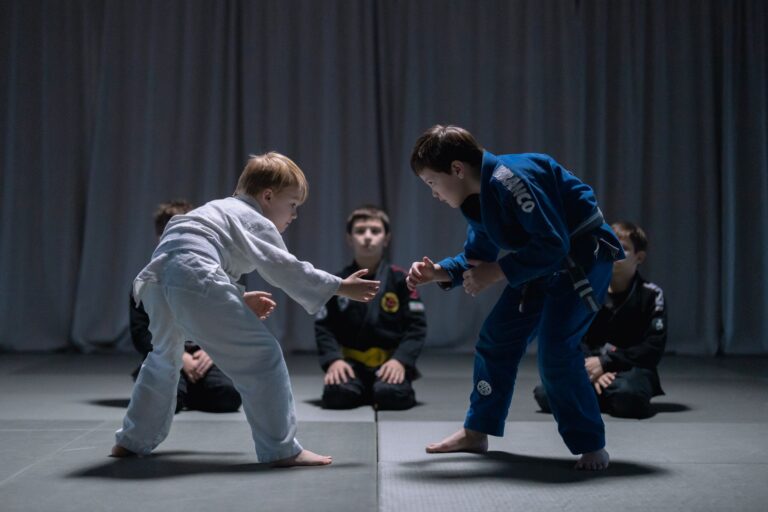
If you’re wondering how kids’ BJJ classes work, you’re likely weighing whether Brazilian Jiu-Jitsu is the right fit for your child—and that’s exactly the right question to ask. Kids’ BJJ classes blend structured technique instruction with play-based learning, building confidence and discipline in an environment that feels nothing like traditional team sports. Classes are organized by age and skill level, so whether your child is stepping on the mat for the first time or already has some experience, they train alongside peers at their own pace, learning fundamental positions, movements, and problem-solving skills that translate far beyond the mat.
At Trein Club in Houston, kids’ classes emphasize growth over competition, creating a space where shy kids, energetic kids, and kids who’ve never connected with conventional sports all thrive. Instructors—trained by champion-level coaches—focus on building self-esteem, focus, and discipline while keeping training fun and engaging. Classes typically run 45 to 60 minutes and include warm-ups, technique drilling, and controlled partner work, all designed to develop body awareness, respect, and resilience in a supportive, ego-free environment.
How Kids’ BJJ Classes Work: A Complete Overview
Kids’ Brazilian Jiu-Jitsu classes are structured, age-appropriate training sessions that blend martial arts technique with movement education, social development, and character building. Unlike adult programs that often prioritize precision and intensity from day one, children’s sessions are designed around how kids actually learn — through play, repetition, short bursts of focus, and immediate positive reinforcement. At a champion-led academy like Trein Club in Houston’s Oak Forest neighborhood, every children’s class follows a clear arc: a dynamic warm-up, technical instruction broken into digestible pieces, partner drilling under supervision, and controlled live practice that lets students apply what they just learned.
The format is intentionally consistent. Children thrive on routine, and a predictable class structure lowers anxiety for first-timers while giving veterans a framework to measure their own progress. Most kids’ BJJ sessions run between 45 and 60 minutes, are grouped by age and skill level, and are taught by coaches trained specifically to communicate with young students — not just to demonstrate techniques. The result is a sport that looks like fun from the outside but quietly delivers fitness, discipline, focus, and real self-defense skills underneath. For a deeper look at the sport itself, our guide on what Brazilian Jiu-Jitsu is and how it works is a great companion read.
What Happens in a Typical Kids BJJ Class
A typical kids’ BJJ session is divided into four clear phases. Each phase has a specific purpose, and the transitions are designed to keep energy high without letting attention drift. Understanding this rhythm helps parents recognize what their child is learning week to week — and why progress sometimes shows up off the mat before it shows up on it.
Warm-up and Conditioning Phase
The first 8 to 12 minutes are dedicated to warming up the body and waking up the brain. Coaches use a mix of jogging, shrimping, forward and backward rolls, bear crawls, and animal walks — movements that simultaneously build the coordination patterns Jiu-Jitsu depends on. This phase doubles as conditioning, raising the heart rate and improving mobility, balance, and proprioception. For younger students especially, the warm-up is often gamified to make the transition from school or home into focused training feel natural.
Fundamental Technique Instruction
Next, the coach demonstrates one or two techniques tied to the week’s theme — for example, escaping mount, sweeping from guard, or controlling an opponent from side control. Instructions are broken into 2 or 3 simple steps using kid-friendly language (“hide your elbow,” “make a frame,” “shrimp your hips”). Demonstrations are repeated multiple times, and students are often invited to call out the steps back to the coach to reinforce memory.
Drilling and Partner Practice
Once the technique is shown, students pair up and repeat the movement on a cooperating partner. This is where motor learning actually happens. Coaches walk the mat constantly, correcting grip placement, hip angle, and body positioning. Drilling is typically done in sets of 10 repetitions per side and rotated so children work with multiple partners — which also builds social comfort and adaptability.
Live Rolling and Sparring
The last segment is live practice, often called “rolling.” For younger students, this looks more like positional games — starting from a specific position and trying to achieve a goal (escape, sweep, or maintain control). Older and more experienced practitioners engage in full sparring rounds of 2 to 4 minutes, always under close supervision. Live rolling is what turns memorized technique into instinct, and it’s the part most children look forward to.
Age Groups and Class Structure
Grouping students by age and developmental stage is one of the most important elements of a well-run program. A 6-year-old and a 13-year-old need radically different teaching styles, attention spans, and physical challenges. Trein Club organizes its kids’ program into clear tiers so each child trains alongside peers at a similar stage.
Ages 6-8: Beginner Fundamentals
At this age, the priority is movement literacy, listening skills, and falling in love with the sport. Sessions lean heavily on games — tag, king of the hill, sumo, positional chases — wrapped around foundational positions like guard, mount, and side control. Submissions are introduced slowly and almost always taught as escapes first. The goal is confidence on the mat, not technical mastery.
Ages 9-12: Intermediate Skills Development
This is the sweet spot for skill acquisition. Students in this age range can absorb more detailed technique, handle longer drilling sets, and start understanding the strategic “why” behind each movement. Sessions introduce a wider technical vocabulary: collar chokes, armbars, triangles, sweeps, and guard passing concepts. Live rolling becomes more regular, and many children in this group begin competing locally if they choose.
Ages 13-14: Advanced Techniques and Competition Prep
Teen classes start to resemble adult fundamentals sessions in structure, with more emphasis on conditioning, technical precision, and tactical decision-making. Students learn to chain techniques together, build personal games, and study positional concepts in depth. Those who want to compete get specialized prep, including weight management education — our breakdown of BJJ competition weight categories is a useful resource for parents whose kids are entering tournaments.
Key Teaching Methods for Kids BJJ
The techniques in kids’ BJJ are essentially the same as those taught to adults — but the methodology is completely different. Effective youth instruction relies on three core teaching pillars.
Game-Based Learning Approach
Children learn movement better through games than through lectures. A coach who wants to teach hip escape doesn’t lecture about hip mechanics — they run a game where students have to shrimp across the mat to grab a cone before their partner tags them. The technique gets internalized through play, and children stay engaged for the full hour because it never feels like school.
Progressive Belt System and Achievement Goals
Kids’ BJJ uses a separate belt system from adults, with colored belts and stripes designed to mark visible progress every few months. This sense of achievement is powerful. Every stripe earned is proof of consistency and growth, and the ceremony of promotion teaches young students that real rewards come from effort over time. For context on how the adult system works, our guide to the BJJ belt system explains the long-term progression they’re building toward.
Safety-First Training Environment
Safety is the non-negotiable foundation. Coaches enforce strict rules around control, tapping, and respecting partners. Heel hooks, neck cranks, and slamming are banned. Mats are cleaned regularly, and class sizes are kept manageable so every child gets eyes on them. The result is a sport that, despite involving real grappling, has injury rates far lower than soccer, basketball, or football.
Benefits of Kids BJJ Classes
Parents come to Trein Club for many reasons, but most stay because of the changes they see in their child within the first few months.
Physical Fitness and Coordination Development
BJJ is a full-body workout disguised as play. Children develop strength, flexibility, cardiovascular endurance, balance, and spatial awareness all at once. Because the sport requires using both sides of the body symmetrically, it builds the kind of well-rounded athleticism that transfers to every other sport.
Mental Discipline and Focus
Following multi-step instructions, executing under pressure, and managing emotions during live rolling all train executive function. Many parents report that their child’s focus at school improves noticeably within a few months of consistent training.
Confidence Building and Self-Defense Skills
BJJ gives children a quiet, grounded confidence — they know they can handle themselves physically without ever needing to prove it. This is particularly powerful for shy students or those who’ve been bullied. They learn to control situations without aggression, which is the highest form of self-defense.
Social Development and Teamwork
Youth classes are inherently social. Students rotate through partners, learn to communicate physically, and build friendships through shared challenge. The culture at Trein Club — “organized like a team, fighting like a family” — gives children a strong sense of belonging that extends beyond the mats.
Important Lessons Instructors Teach Beyond Technique
Ask any longtime BJJ parent what their child has learned, and they’ll rarely list techniques first. The lasting lessons are about character.
Respect and Discipline
Bowing onto the mat, addressing coaches as “professor,” shaking hands before and after rolls, and respecting belt rank teach young students that structure and respect create the conditions for growth. Discipline isn’t punishment — it’s the daily habit of showing up and giving real effort.
Perseverance and Problem-Solving
Every roll is a puzzle. When a child gets stuck in a bad position, they learn to stay calm, breathe, and work step by step toward an escape. This pattern — calm under pressure, methodical problem-solving — is one of the most transferable life skills BJJ teaches.
Humility and Learning from Mistakes
Students tap. They lose positions. They get caught by techniques they didn’t see coming. And then they shake hands, reset, and go again. BJJ normalizes failure as a tool for growth, which is one of the rarest and most valuable lessons any sport can offer a child.
Curriculum and Training Games Used in Kids Classes
The day-to-day curriculum mixes technical instruction with games specifically designed to develop Jiu-Jitsu instincts.
Positional Escape Games
One partner starts in a dominant position (mount or side control) and the other has 30-60 seconds to escape. These exercises teach defensive composure and reinforce escape mechanics under realistic pressure.
Tag and Chase Drills
Simple chase games on knees or hands and knees develop the hip movement, takedown timing, and grip-fighting reactions that underpin live grappling — all while students think they’re just playing.
Submission Defense Exercises
Children learn to recognize and defend against common submissions long before they’re encouraged to attack with them. This defense-first approach keeps training safe and builds a deep understanding of how each submission works mechanically. Just as important, coaches teach which techniques are not allowed in BJJ so students internalize the rules early.
What Works Best in Kids BJJ Programs
Years of running youth programs make it clear which factors separate a great experience from a mediocre one.
Keeping Classes Fun and Engaging
Fun isn’t a bonus — it’s the engine. Children who enjoy class show up consistently, and consistency is what produces every benefit BJJ offers. Coaches who can balance discipline with genuine enthusiasm get the best long-term results.
Consistent Attendance and Routine
Two sessions a week is the minimum threshold where real progress compounds. Skill, fitness, and confidence all grow on a slope that rewards showing up — not on a single intensive push.
Parent Involvement and Communication
Parents who watch class, ask questions, celebrate stripes, and gently encourage practice at home accelerate their child’s growth. Coaches at Trein Club actively communicate with families about progress, challenges, and what to reinforce outside the academy.
Common Challenges in Teaching Kids BJJ
Even the best programs navigate real challenges every week. Knowing how a good academy handles them is a useful signal for parents.
Managing Different Skill Levels in One Class
Within any age group, you’ll have first-timers and students with two years of experience. Skilled coaches use tiered drills (basic version, advanced version), thoughtful partner pairings, and small-group breakouts so every child is appropriately challenged.
Maintaining Focus and Attention Span
A 7-year-old’s attention span isn’t built for 30 minutes of static drilling. Effective coaches change activities every 5-8 minutes, use clear voice cues, and intersperse short bursts of high-energy games with focused technique work.
Balancing Safety with Realistic Training
Children need real practice to develop real skill, but coaches must constantly calibrate intensity to keep training safe. Strict tap rules, banned techniques, weight- and size-aware pairings, and constant supervision are all part of how Trein Club keeps live training both meaningful and safe.
FAQ: What is the ideal class duration for kids BJJ?
The ideal class length depends on age. For students 6-8, 45 minutes is the sweet spot — long enough to cover warm-up, technique, and a game-based application without losing focus. For ages 9-12, 50-60 minutes works well and allows time for live rolling. Teen sessions (13-14) can run a full hour or slightly longer, mirroring an adult fundamentals format. Beyond these durations, attention and energy typically drop off, and the quality of learning declines.
FAQ: At what age can children start BJJ classes?
Most academies, including Trein Club, accept children starting around age 4-6, with formal beginner sessions beginning at 6. At 4-5, students can participate in pre-BJJ movement classes that focus on listening skills, body awareness, and basic motor patterns. By 6, most are ready for structured fundamentals classes. There’s truly no upper limit — teenagers starting fresh at 13 or 14 progress quickly thanks to their physical maturity and ability to absorb complex concepts.
FAQ: How often should kids attend BJJ classes per week?
Two sessions per week is the minimum for steady progress and is what most youth programs are built around. Three sessions per week accelerates skill development significantly and is ideal for children who genuinely love the sport or are preparing for competition. Daily training isn’t necessary or recommended at young ages — rest, school, free play, and other activities all matter for healthy development. Consistency over months and years matters far more than any individual week’s volume.