If you’re curious about stand-up striking sports, understanding the difference between kickboxing, Muay Thai, and boxing is essential—especially if you’re deciding which discipline fits your goals. While all three are combat sports built on footwork, timing, and precision, they differ significantly in technique, rules, and the range of strikes allowed. Boxing focuses purely on hand strikes and head movement; kickboxing adds kicks to the mix for a more dynamic stand-up game; and Muay Thai, known as “the art of eight limbs,” incorporates punches, kicks, elbows, and knees, making it the most comprehensive striking system. At Trein Club in Houston, our striking program blends all three disciplines so you can develop well-rounded stand-up skills regardless of your experience level. Whether you’re a complete beginner exploring combat sports for the first time, a fitness enthusiast looking to cross-train, or someone serious about self-defense, learning these distinctions helps you understand which style—or combination—serves your needs best. Each offers unique benefits for conditioning, confidence, and real-world application.
Quick Answer: Kickboxing, Muay Thai, and Boxing at a Glance
Boxing, kickboxing, and Muay Thai are three striking arts that appear similar from the outside but follow very different rulebooks and philosophies. Boxing permits only punches above the waist and rewards head movement, footwork, and hand speed. Kickboxing layers kicks on top — a hybrid style born in the 1960s and 70s that fuses Western pugilism with karate-style leg techniques. Muay Thai, the national sport of Thailand, is called the “Art of Eight Limbs” because it uses fists, shins, elbows, knees, and includes a standing grappling phase known as the clinch.
In short: the more weapons allowed, the more techniques you’ll learn. Boxing works with two points of contact (fists), kickboxing with four (fists and shins/feet), and Muay Thai with eight (fists, shins, elbows, and knees) plus clinch work. Each discipline has its own stance, scoring system, and ideal use case for self-defense, fitness, or competition.
What Is Boxing? Rules, Techniques, and Core Principles
Boxing is the oldest and most codified of the three, with modern rules tracing back to the Marquess of Queensberry code of 1867. Two fighters wear padded gloves and exchange punches inside a roped ring over timed rounds. The sport rewards precision, timing, defensive intelligence, and cardiovascular endurance far more than raw power.
Permitted Strikes in Boxing: Punches Only
Boxing legally allows only four punches — the jab, cross, hook, and uppercut — thrown above the waist and to the front or sides of the opponent’s head and torso. Rabbit shots (to the back of the head), kidney blows, and hitting below the belt are illegal. There are no kicks, knees, elbows, headbutts, throws, or clinch strikes. This narrow toolkit is precisely why boxers develop such refined hand technique: with fists as the only weapon, everything else — head movement, footwork, distance, timing — gets sharpened to elite levels.
Boxing Stance, Footwork, and Defensive Fundamentals
The classic boxing stance is bladed, with the lead shoulder slightly forward, chin tucked, and hands high near the cheeks. Weight distribution sits roughly 50/50, and footwork favors short, quick steps, pivots, and angle changes. Because a boxer has no kicks to defend against, they can stand closer, dip lower, and use aggressive head movement — slips, rolls, and pull-counters — without worrying about eating a shin to the ribs. Defensive fundamentals include the parry, block, slip, roll, and clinch (a passive tie-up, not a striking clinch as in Muay Thai).
What Is Kickboxing? Origins, Rules, and Techniques
Kickboxing emerged in the 1960s and 70s as karate practitioners in Japan and the United States sought a full-contact ruleset that combined Western boxing punches with karate and taekwondo kicks. Unlike Muay Thai, which carries centuries of cultural history, kickboxing is a modern, sport-first invention with several regional variants.
Permitted Strikes in Kickboxing: Punches and Kicks
Kickboxers can use all standard boxing punches plus kicks to the legs, body, and head, depending on the ruleset. Roundhouse kicks, front kicks (teeps), side kicks, spinning back kicks, and axe kicks all appear regularly. Footwork tends to be lighter and more mobile than in Muay Thai because kickboxers need to enter, strike, and exit quickly without getting caught in a clinch.
Major Kickboxing Styles: American, Japanese, and Dutch
Three dominant kickboxing traditions stand out. American kickboxing (or “full contact karate”) permits punches and kicks above the waist only — no leg kicks. Japanese kickboxing, popularized by K-1, allows punches, kicks (including low kicks), and sometimes limited knee strikes but generally bans elbows and prolonged clinching. Dutch kickboxing — the style behind fighters like Ernesto Hoost, Ramon Dekkers, and modern stars such as Alex Pereira — is famous for aggressive boxing combinations chained into brutal low kicks and body kicks, blurring the line with Muay Thai.
What Kickboxing Does NOT Allow: No Elbows, Knees, or Clinch
In most kickboxing rulesets, elbow strikes are banned, knee strikes are restricted or prohibited, and the clinch is broken up almost immediately by the referee. This keeps the pace fast and the exchanges clean but eliminates a huge portion of the close-range arsenal that defines Muay Thai. If you want a deeper breakdown of how to begin, our guide on how to start training kickboxing walks through gear, first classes, and expectations.
What Is Muay Thai? The Art of Eight Limbs Explained
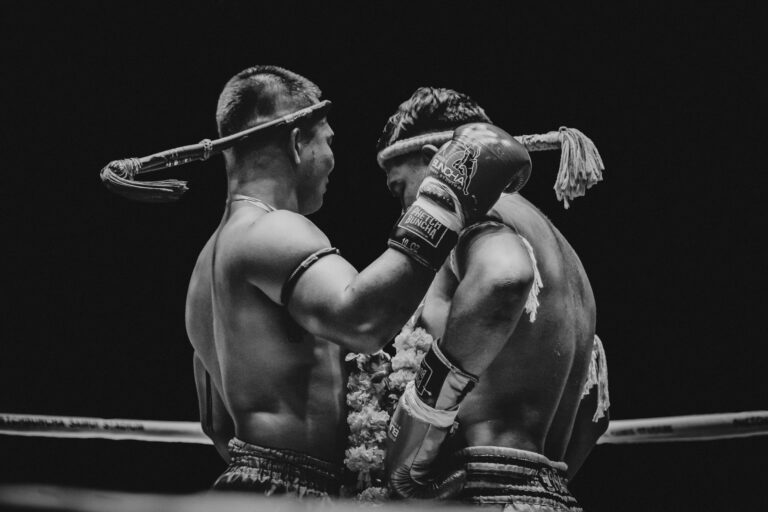
Muay Thai is Thailand’s national sport and a centuries-old martial tradition. Modern bouts feature ring music (sarama), a pre-fight ritual dance (wai kru ram muay), and a scoring system that rewards damage, balance, and dominant technique — not simple point accumulation. Many consider it the most complete striking art in the world.
Permitted Strikes in Muay Thai: Punches, Kicks, Elbows, and Knees
The nickname “Art of Eight Limbs” refers to the eight weapons a Nak Muay wields in combat: two fists, two shins, two elbows, and two knees. Elbows travel horizontally, diagonally, upward, and even in spinning arcs, and they rank among the most common causes of stoppages due to cuts. Knees fire at range (long knees, jumping knees) and, more importantly, from inside the clinch. This expanded toolkit reshapes everything about strategy, distance management, and conditioning.
The Clinch (Plum): Muay Thai’s Most Distinctive Feature
The clinch — specifically the double-collar tie or “plum” — is what most separates Muay Thai from every other striking sport. Fighters battle for head and neck control, break posture, and land knees to the body and head or elbows to the face. Sweeps and off-balances are legal and count toward scoring. This gives Muay Thai a hybrid feel that bridges pure striking and grappling, and it explains why the sport transfers so well to MMA.
Muay Thai Kicks vs. Kickboxing Kicks: Key Technical Differences
A Muay Thai roundhouse is thrown with the shin (not the instep), the whole body rotating like a baseball bat swing while the standing foot pivots fully. Chambering is minimal — the leg travels in one arcing motion. A kickboxing roundhouse, especially in American and traditional Japanese styles, often chambers the knee first and snaps the foot or lower shin into the target, prioritizing speed and retraction. Muay Thai kicks are heavier and more damaging; kickboxing kicks are typically faster and easier to recover from. For a deeper self-defense comparison, see our analysis on kickboxing vs Muay Thai.
Side-by-Side Comparison: Kickboxing vs. Muay Thai vs. Boxing
Here’s how the three arts stack up across the criteria that matter most for anyone deciding where to begin.
Allowed Weapons: Strikes, Clinch, and Grappling Rules
- Boxing: Punches only (jab, cross, hook, uppercut). No clinch striking. No kicks, knees, or elbows.
- Kickboxing: Punches and kicks. No elbows. Knees usually restricted. Clinch broken quickly.
- Muay Thai: Punches, kicks, elbows, knees. Extended clinch with sweeps and knee strikes fully legal.
Stance and Footwork Differences Across All Three Styles
Boxers stand bladed with weight balanced, using constant lateral movement and head motion. Kickboxers stand slightly more square to check kicks and throw their own, with lighter, bouncier footwork. Muay Thai fighters stand the most squared and upright, with weight often loaded on the back leg so the lead leg can teep or check quickly. Muay Thai footwork is deliberate and grounded — not because Nak Muay lack agility, but because being on your toes in the clinch gets you swept.
Scoring Systems and Competition Rules Compared
Boxing scores clean, effective punches under the 10-point must system, emphasizing volume, defense, and ring generalship. Kickboxing scoring varies by promotion but generally rewards knockdowns, effective aggression, and clean strikes across all rounds. Traditional Muay Thai scoring is unique: early rounds are often feeling-out rounds scored lightly, while championship rounds (3 and 4 in a 5-round fight) carry the most weight. Judges reward dominance, balance, and heavy strikes — a fighter who lands one devastating body kick will often score higher than one who lands ten flashy punches.
Which Is Better for Self-Defense: Kickboxing, Muay Thai, or Boxing?
All three build real self-defense value because they train you under resistance — pad work, sparring, and pressure. That said, they emphasize different skills. Boxing gives you elite hands, head movement, and the ability to end confrontations quickly with a single punch, which is enormously useful in real-world encounters that often start at punching range. Kickboxing broadens that toolkit with kicks, useful for creating distance from a threat.
Muay Thai tends to be the most complete stand-up self-defense system because it prepares you for close-quarters chaos: elbows for tight spaces, knees for the clinch, and the plum position itself for controlling a bigger, aggressive attacker. Paired with Brazilian Jiu-Jitsu — which handles the fight if it goes to the ground — Muay Thai forms one of the most practical self-defense combinations available. That’s exactly why Trein Club offers both under one roof.
Which Is Better for Fitness and Weight Loss?
All three burn serious calories — typically 500 to 1,000 per hour depending on intensity — but they train the body differently. Boxing is a masterclass in cardiovascular conditioning, shoulder endurance, and reactive footwork. Kickboxing adds lower-body power and hip mobility, making it one of the most balanced full-body workouts available. Muay Thai, thanks to shin conditioning, clinch wrestling, and knee strikes, builds unmatched core strength and grip endurance.
For pure weight loss, the discipline you’ll enjoy most and attend most consistently is the best one. Our detailed breakdown on whether kickboxing is a good workout for losing weight covers calorie burn, class structure, and how to pair striking with strength training for maximum results.
Which Should a Beginner Learn First?
There’s no universally correct answer, but a few guidelines help. If you want the shortest learning curve and the most immediately usable skills, start with boxing. Fewer techniques mean faster mastery of stance, distance, and rhythm. If you want a well-rounded workout with punches and kicks but don’t want the physical intensity of shin conditioning and clinch work, start with kickboxing. If you want the deepest, most complete striking art and don’t mind a longer learning curve, start with Muay Thai.
At Trein Club, our striking program deliberately blends all three so beginners get exposure to the full spectrum without having to choose. You’ll build clean boxing hands, learn kicks properly, and develop the elbows, knees, and clinch of Muay Thai — all within one class structure.
How Each Discipline Builds on the Others
Boxing is the foundation of hand technique for every striking art. A kickboxer with poor hands will always hit a ceiling; a Muay Thai fighter without boxing fundamentals gets outboxed in the pocket. Kickboxing bridges boxing and Muay Thai by adding kicks without the complexity of the clinch. Muay Thai then layers on elbows, knees, and clinch work. The natural progression is boxing → kickboxing → Muay Thai, but skilled coaches integrate all three simultaneously so students don’t hit plateaus.
Injury Risks: Which Combat Sport Is Safer?
Every combat sport carries risk, but the profiles differ. Boxing shows the highest rate of concussions and long-term brain trauma per bout because every legal strike targets the head with a padded but heavy fist. Kickboxing distributes damage across the body — leg kicks, body kicks, and head strikes — reducing repetitive head trauma but adding lower-body injuries like bruised shins and hip strains. Muay Thai sees higher rates of cuts (thanks to elbows) and shin injuries during conditioning, yet studies of amateur and recreational practitioners actually show lower concussion rates than boxing because damage is spread across eight weapons rather than concentrated on the skull.
For recreational training — which is what 99% of gym members do — all three are remarkably safe when taught properly with controlled sparring, quality gear, and progressive intensity.
FAQ: Is Muay Thai the same as kickboxing?
No. Muay Thai allows elbows, knees, and extended clinch work; kickboxing generally does not. Muay Thai kicks are thrown with the shin using a rotational, whole-body motion, while kickboxing kicks are typically snappier and more chambered. They share some techniques but remain distinct sports with different rulesets, scoring systems, and cultural roots.
FAQ: Can a boxer beat a Muay Thai fighter?
Under boxing rules, yes — a top boxer will almost always beat a Muay Thai fighter who can’t kick. Under Muay Thai or MMA rules, the boxer is at a serious disadvantage because leg kicks, teeps, elbows, and the clinch neutralize pure punching. In a real self-defense scenario at punching range, a skilled boxer is extremely dangerous; at kicking or clinch range, the Muay Thai fighter has a decisive edge.
FAQ: What is the main difference between a Muay Thai kick and a kickboxing kick?
The Muay Thai roundhouse rotates the entire body like a baseball bat, connects with the shin, and pivots the standing foot fully — it’s heavy and designed to damage. A traditional kickboxing roundhouse chambers the knee first and snaps the foot or lower shin into the target, prioritizing speed and quick retraction. Dutch kickboxing has narrowed this gap significantly by adopting Muay Thai-style low kicks.
FAQ: Which is harder to learn: boxing, kickboxing, or Muay Thai?
Boxing has the shortest technical inventory but the deepest nuance — mastering four punches under pressure is a lifelong pursuit. Kickboxing offers more techniques than boxing but a cleaner ruleset than Muay Thai. Muay Thai is the most technically demanding because you have to develop eight weapons plus clinch work. For pure beginners, boxing feels easiest to grasp in the first month; Muay Thai takes longer to feel comfortable in.
FAQ: Can you use elbows and knees in kickboxing?
In most mainstream kickboxing rulesets — American, traditional Japanese, K-1 — elbows are banned and knees are heavily restricted or prohibited. Some hybrid rulesets like Glory Kickboxing allow limited knees but no elbows. If elbows and knees are legal, you’re almost certainly watching Muay Thai or a modified Muay Thai rule set, not kickboxing.
FAQ: Is Muay Thai more effective than kickboxing in MMA?
Historically, yes — Muay Thai has been the dominant striking base for MMA because elbows, knees, and clinch skills transfer directly to the cage. That said, elite Dutch-style kickboxers like Alex Pereira and Israel Adesanya have proven that high-level kickboxing paired with strong takedown defense can be equally effective. The best MMA strikers today typically train both, along with boxing.
FAQ: How long does it take to get good at each discipline?
Expect roughly 6–12 months of consistent training (3+ classes per week) to feel competent in boxing, 12–18 months for kickboxing, and 18–24 months for Muay Thai. “Good” enough to spar confidently and defend yourself comes sooner; competition-level skill takes years in any of them. The best predictor isn’t the art you choose — it’s how often you show up. Our striking program at Trein Club is built to make showing up easy, and you can book a striking trial class in Oak Forest to experience all three disciplines in one session.