Vinyasa flow is a dynamic, breath-synchronized style of yoga that links movement with intention—and if you’ve ever felt stuck in a rigid fitness routine, it’s exactly what your body and mind have been searching for. Unlike static stretching or machine-based workouts, vinyasa flow creates a moving meditation that builds strength, flexibility, and mental clarity all at once. At Trein Club in Houston, our yoga program—led by Pedro Araujo, a 4x Jiu-Jitsu World Champion and 500+ hour certified yoga trainer—uses vinyasa flow specifically to enhance athletic performance, deepen mobility, and help you recover smarter after intense training.
Whether you’re a martial artist looking to move with more fluidity, a busy professional seeking stress relief, or someone completely new to yoga, vinyasa flow meets you where you are. The practice isn’t about forcing your body into shapes; it’s about discovering what your body is capable of when breath and movement align. At Trein Club, we believe recovery and intention are just as important as the training itself, which is why vinyasa flow sits at the heart of our wellness philosophy alongside Brazilian Jiu-Jitsu, strength conditioning, and our full recovery suite.
What Is Vinyasa Flow? A Complete Beginner’s Guide
Vinyasa flow is a dynamic style of yoga in which every movement is deliberately paired with a breath, creating a continuous, dance-like sequence of postures rather than a series of static holds. If you’ve ever watched a yoga class that resembles a smoothly choreographed wave of bodies moving in unison, breathing audibly, and transitioning from downward dog to plank to warrior — that’s vinyasa. It’s currently the most widely taught style in the United States, and for good reason: it builds strength, flexibility, cardiovascular endurance, and mental focus simultaneously, while remaining accessible to nearly anyone willing to show up on a mat.
This guide breaks down exactly what vinyasa flow is, where it originated, how it compares to other yoga styles, what happens in a typical class, and how to begin practicing without feeling intimidated. Whether you’re a martial artist looking to improve mobility, a parent searching for stress relief, or a complete beginner curious about yoga, you’ll walk away with a clear picture of whether this practice is the right fit for you.
The Core Definition: What ‘Vinyasa’ Actually Means
Before you can grasp vinyasa flow, you need to understand what the word itself communicates. Vinyasa isn’t a modern marketing term — it’s an ancient Sanskrit concept describing a very specific relationship between intention, breath, and movement.
The Sanskrit Root: Breaking Down the Word ‘Vinyasa’
“Vinyasa” comes from two Sanskrit roots: nyasa, meaning “to place,” and the prefix vi, meaning “in a special way.” Together, they translate roughly to “to place in a special way” or “to arrange with intention.” Within the classical yoga tradition, the term refers to the mindful, purposeful sequencing of one thing after another — each posture, each breath, each transition placed with awareness rather than executed randomly. For a deeper etymological breakdown, our companion article on what does vinyasa flow mean unpacks the linguistic and philosophical layers further.
How ‘Flow’ Transforms Vinyasa Into a Moving Meditation
The word “flow” was added by Western teachers to capture how intentional sequencing feels in practice: seamless, continuous, and meditative. Instead of pausing to think between poses, you move with your inhale and exhale, linking postures into a single unbroken thread. That’s what turns vinyasa from a collection of shapes into a moving meditation — the mind becomes so occupied syncing breath and body that it stops rehearsing your to-do list. Which is why practitioners often describe this style as the closest they get to genuine mental quiet.
How Vinyasa Flow Differs From Other Yoga Styles
Yoga is an umbrella term covering dozens of distinct styles, and vinyasa is often confused with its close cousins. Understanding the differences helps you choose the right class and avoid signing up for something that doesn’t match your goals.
Vinyasa vs. Hatha Yoga: Pace, Structure, and Intention
Hatha yoga is slower and more static, focusing on holding individual poses for longer periods with detailed alignment instruction. Vinyasa takes those same shapes and links them together with breath-driven transitions. If hatha is a series of well-composed photographs, vinyasa is the film. Beginners who want to memorize alignment often start with hatha; those who prefer feeling their heart rate rise and their mind quiet through movement usually gravitate toward vinyasa.
Vinyasa vs. Ashtanga Yoga: Fixed Sequence vs. Creative Freedom
Ashtanga follows a fixed, predetermined series of poses that never changes — the Primary Series, Second Series, and so on. Every session in a traditional Ashtanga studio moves through the same order. Vinyasa is essentially Ashtanga’s more creative sibling: it borrows the breath-linked structure but allows teachers to design new sequences each class, building toward different peak poses and themes. This makes the practice less predictable but also more engaging for people who get bored with repetition.
Vinyasa vs. Power Yoga: Intensity and Accessibility
Power yoga is a fitness-forward offshoot of vinyasa, developed in the 1990s to appeal to gym-goers. It emphasizes strength, sweat, and athletic conditioning, often with less spiritual framing. Vinyasa can be equally intense but tends to preserve more of the meditative, breath-first ethos. Think of power yoga as vinyasa with the volume turned up on the fitness dial and turned down on the philosophy.
The 10 Key Elements That Define Every Vinyasa Flow Class
No two vinyasa classes look exactly alike, but nearly all of them share a common vocabulary of ingredients. Understanding these ten elements will help you follow along in your first class instead of feeling lost.
1. Breath-to-Movement Synchronization (The Foundation)
This is the non-negotiable heart of the practice. Every movement is initiated by either an inhale or an exhale. Lifting the arms overhead? Inhale. Folding forward? Exhale. When the breath leads the body, the practice becomes both a physical workout and a nervous system regulator.
2. Sun Salutation as the Building Block
Nearly every class opens with several rounds of Surya Namaskar — the Sun Salutation. This flowing sequence of about a dozen poses (mountain, forward fold, halfway lift, chaturanga, upward dog, downward dog, and back) warms the body and establishes the breath-movement rhythm you’ll use throughout the rest of class.
3. Transitions as Poses: Why the Journey Matters
In vinyasa, how you move between poses matters as much as the poses themselves. Stepping from downward dog into a lunge, for example, is treated as its own posture requiring core engagement and mindfulness — not just a throwaway movement to get somewhere else.
4. Creative, Non-Scripted Sequencing
Teachers design sequences around themes, peak poses, or anatomical focuses (hips, shoulders, backbends). This creativity means you rarely take the same class twice, which keeps the practice mentally engaging over years of training.
5. Ujjayi Pranayama: The Signature Vinyasa Breath
Ujjayi, sometimes called “ocean breath,” is a slight constriction at the back of the throat that produces an audible, soothing sound on both inhale and exhale. It regulates breath length, generates internal heat, and acts as an auditory anchor for the mind.
6. Drishti: Using a Focused Gaze to Anchor the Mind
Drishti is a specific gaze point held during each pose — the tip of the nose, the horizon, the thumb, the ceiling. By fixing your eyes, you fix your attention, which improves balance and prevents mental wandering.
7. Bandhas: Internal Energy Locks That Support the Body
Bandhas are subtle muscular engagements — the pelvic floor (mula bandha) and lower belly (uddiyana bandha) — that stabilize the spine, protect the low back, and generate lift during transitions. Advanced practitioners rely on them constantly.
8. Heat Generation and Physical Challenge
The combination of continuous movement, ujjayi breath, and bandha engagement generates significant internal heat. You will sweat. This warmth is considered therapeutic — it loosens connective tissue, mobilizes joints, and supports detoxification through perspiration.
9. Savasana: The Essential Rest That Completes the Practice
Every class closes with savasana — corpse pose — a five- to ten-minute period of complete stillness. This isn’t optional; it’s where the nervous system integrates the practice. Skipping it is like closing a book mid-sentence.
10. Music and Atmosphere: Setting the Flow
Many modern classes use curated playlists that rise and fall with the intensity of the sequence. Lighting, temperature, and instructor tone all contribute to the atmosphere. This is one of the reasons vinyasa has become so popular in boutique studios — the environment itself is designed to help you drop into the practice.
What to Expect in Your First Vinyasa Flow Class
Walking into a yoga studio for the first time can feel intimidating. Knowing the general shape of a class removes most of that anxiety.
Typical Class Structure: Warm-Up, Peak Pose, Cool-Down
A standard 60-minute session follows a predictable arc: five to ten minutes of centering and gentle warm-up, ten to fifteen minutes of sun salutations to build heat, twenty to thirty minutes of standing poses and creative sequencing building toward a peak pose (like a challenging arm balance or backbend), five to ten minutes of seated stretches and hip openers, and a closing savasana.
Common Poses You Will Encounter as a Beginner
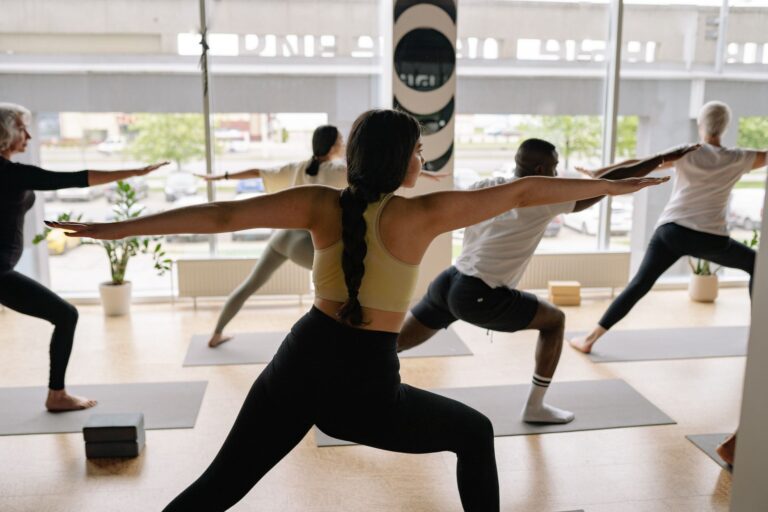
Expect to meet downward-facing dog, plank, chaturanga (a low push-up), upward-facing dog, mountain pose, forward fold, warrior I, warrior II, triangle, chair pose, child’s pose, and pigeon. These roughly two dozen postures form the backbone of most classes. Once you know them, you can follow along in any studio in the world.
How Long Are Vinyasa Flow Classes? (30, 60, and 90-Minute Formats)
Thirty-minute express classes are increasingly common and great for busy schedules — they cut straight to sun salutations and a short peak. Sixty minutes is the standard and delivers a complete arc. Ninety-minute sessions allow for longer warm-ups, more challenging peaks, and a fuller savasana; they’re ideal for weekend practice.
The Physical and Mental Benefits of Vinyasa Flow Yoga
The reason this style has spread globally isn’t marketing — it’s that the benefits are measurable and appear quickly.
Cardiovascular Fitness and Calorie Burn
A vigorous 60-minute class burns between 400 and 550 calories for the average adult and elevates heart rate into moderate aerobic zones. It’s one of the few strength-focused practices that also delivers meaningful cardio.
Strength, Flexibility, and Balance Gains
Holding chaturanga, plank, and warrior variations builds deep functional strength in the shoulders, core, and legs. The repeated forward folds, backbends, and hip openers systematically improve flexibility. Balance postures like tree, eagle, and half-moon train proprioception. This combination is exactly why we recommend the practice to grapplers and strikers — you can read more in our guide on yoga for athletes.
Stress Reduction, Mindfulness, and Mental Clarity
The breath work activates the parasympathetic nervous system, lowering cortisol and improving heart rate variability. Regular practitioners consistently report better sleep, reduced anxiety, and stronger emotional regulation. For working professionals and parents especially, this is often the benefit that keeps them coming back.
Evidence-Based Health Benefits Supported by Research
Peer-reviewed studies have linked consistent vinyasa-style practice to reduced blood pressure, improved insulin sensitivity, lower chronic inflammation markers, decreased low-back pain, and better mental health outcomes in populations ranging from adolescents to older adults. Combat athletes in particular benefit from the mobility and recovery gains — we go deeper into this in why yoga is good for athletes.
Is Vinyasa Flow Right for You? Honest Pros and Cons
The style is popular, but it isn’t universal medicine. Being honest about who it serves — and who it doesn’t — saves everyone frustration.
Who Thrives in Vinyasa Flow (and Who Might Struggle)
People who love variety, enjoy moderate physical challenge, and respond well to being guided through a sequence tend to thrive. People who need very detailed alignment cues for every pose, who have significant wrist or shoulder injuries, or who prefer complete silence and stillness may struggle at first and might do better with hatha, restorative, or Iyengar yoga initially.
Modifications and Props: Making Vinyasa Accessible at Any Level
Blocks, straps, bolsters, and knees-down variations exist for a reason. A skilled teacher offers modifications in every pose — dropping to knees during chaturanga, placing blocks under the hands in forward folds, or skipping optional binds. You’re never expected to do the “hardest” version of anything.
When to Choose a Different Style Instead
If you’re recovering from an acute injury, deeply new to any kind of movement, or specifically seeking a restorative practice for sleep and nervous system recovery, consider yin yoga, restorative yoga, or a beginner-labeled hatha class for your first few weeks before jumping into a flow-based practice.
How to Start Practicing Vinyasa Flow: Practical Next Steps
The best way to understand this style is to take one class. Everything else is preparation.
What to Wear, Bring, and Set Up for Your First Class
Wear form-fitting athletic clothing that won’t slide when you invert — leggings, fitted shorts, and a snug top work well. Bring a water bottle, a mat (most studios rent them), and a small towel. Arrive fifteen minutes early to sign in, meet the instructor, and mention any injuries. Eat lightly at least ninety minutes before class.
Online vs. In-Studio Vinyasa: Which Is Better for Beginners?
Online classes are convenient and inexpensive but offer zero real-time correction, which matters most in your first months when you’re building movement patterns. Beginners almost always progress faster in-studio, where a teacher can adjust your alignment and where the energy of a group class helps you push through the hard moments. Once you have twenty or thirty sessions under your belt, online supplementation becomes genuinely useful.
How Often Should You Practice Vinyasa Flow Each Week?
Two to three classes per week is the sweet spot for most beginners — enough to build skill and see benefits, not so much that you burn out or get injured. Advanced practitioners often train four to six days a week, mixing vigorous sessions with slower styles for recovery. At Trein Club in Houston, our vinyasa flow classes are led by Pedro Araujo, a 4x Jiu-Jitsu World Champion and 500+ hour certified yoga trainer, and are designed to complement athletic training as well as stand alone as a complete wellness practice.
Frequently Asked Questions About Vinyasa Flow
Is vinyasa flow yoga good for beginners?
Yes, provided you pick a class labeled “all levels,” “foundations,” or “beginner.” The continuous flow can feel fast at first, but the poses themselves are the same fundamentals every yoga style uses. Most people find their rhythm within three to five classes.
How is vinyasa flow different from regular yoga?
“Regular yoga” usually refers to hatha in the Western imagination, which involves holding individual poses statically. Vinyasa links those poses together with breath-driven transitions, making the practice more continuous, more cardiovascular, and often more meditative.
Can you lose weight doing vinyasa flow yoga?
Yes. A vigorous class burns 400–550 calories and builds lean muscle mass that raises your resting metabolic rate. Combined with sensible nutrition and three to four practices per week, most people see meaningful body composition changes within eight to twelve weeks.
What does a vinyasa flow sequence look like?
A typical short sequence: inhale into mountain pose, exhale fold forward, inhale halfway lift, exhale step back to plank, lower through chaturanga, inhale upward dog, exhale downward dog. That seven-count flow — often called “a vinyasa” — repeats throughout class as a connective thread between standing poses.
How long does it take to get good at vinyasa flow?
Most people feel competent — meaning they can follow class without confusion — within four to six weeks of two-to-three practices per week. Feeling strong and expressive in the poses typically takes six months to a year. Yoga is a decades-long practice; there is no finish line.
Is vinyasa flow the same as power yoga?
Not exactly. Power yoga is a fitness-focused subset of vinyasa developed in the 1990s. All power yoga is vinyasa, but not all vinyasa is power yoga. Power classes tend to be more athletic and less philosophical; general vinyasa classes preserve more of the traditional breath and mindfulness emphasis.
Do I need to be flexible to start vinyasa flow?
No — this is the single biggest myth about yoga. You start yoga to become flexible; you don’t need to be flexible to start. Beginners often have tight hips, hamstrings, and shoulders, which is exactly why they benefit most.
What is the difference between vinyasa flow and hot yoga?
Hot yoga refers to any yoga practiced in a heated room (typically 90–105°F). Vinyasa refers to the style of sequencing. You can do hot vinyasa (heated room, flowing sequence), non-heated vinyasa, or hot Bikram (a specific 26-pose sequence in extreme heat). The two terms describe different things — style versus temperature.