
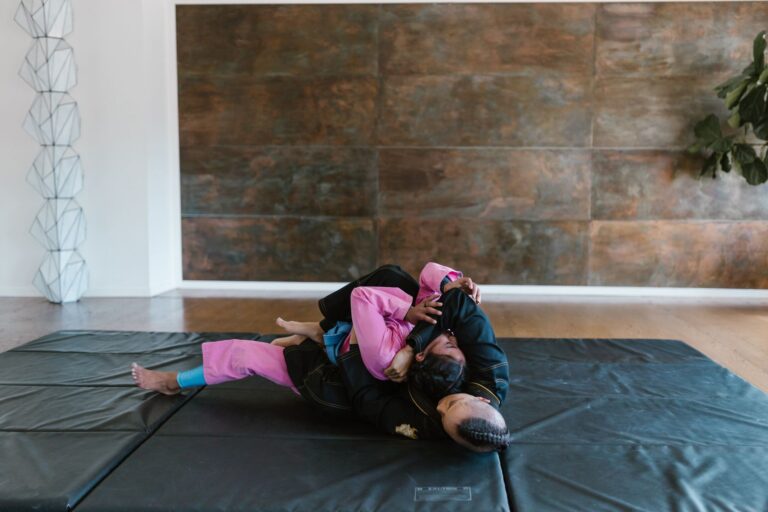
Brazilian Jiu-Jitsu is a martial art centered on grappling and ground fighting techniques that allow a smaller, weaker person to defend themselves against a larger opponent through leverage, timing, and proper technique. Unlike striking-based martial arts, BJJ emphasizes positional control and submission holds—chokes and joint locks—that force an opponent to tap out and concede the match. The art works by systematically breaking down an opponent’s defenses, establishing dominant positions like mount or side control, and then applying techniques that make continuing impossible without risking injury.
At its core, Brazilian Jiu-Jitsu is about problem-solving on the mat. You learn a sequence of movements that chain together—how to escape a bad position, transition to a better one, and eventually submit your opponent. This puzzle-like nature makes BJJ accessible to beginners while remaining endlessly complex for advanced practitioners. Whether you’re rolling casually or training for IBJJF competition, the fundamental principles remain constant: technique over strength, leverage over size, and continuous improvement through repetition.
For those starting their BJJ journey in Houston, understanding these basics helps you appreciate why Brazilian Jiu-Jitsu has become one of the most effective self-defense systems and fastest-growing martial arts worldwide. At Trein Club, our world-class instructors break down these principles for complete beginners, competitive athletes, and everyone in between.
What is Brazilian Jiu-Jitsu: Definition and Core Principles
Brazilian Jiu-Jitsu (BJJ) is a grappling-based martial art and combat sport that prioritizes technique, leverage, and positional control over raw strength and speed. Emerging from Japanese judo and traditional jujutsu, BJJ was refined and systematized in Brazil during the early 20th century, establishing itself as a distinct discipline centered on ground fighting and submission techniques. Unlike striking arts, it focuses on taking opponents to the ground and controlling them through joint locks, chokes, and positional dominance.
The philosophy underlying this martial art rests on a fundamental principle: a smaller, weaker person can successfully defend and overcome a larger, stronger opponent through proper technique, timing, and leverage. This democratizing aspect makes it accessible to people of all body types, ages, and physical conditions. The sport has evolved into both a competitive discipline with international tournaments and a practical self-defense system taught worldwide.
The Fundamentals of Brazilian Jiu-Jitsu as a Martial Art
At its core, this martial art operates on fundamental principles that distinguish it from other combat sports. The art emphasizes the importance of positioning before submission—meaning that controlling where your opponent is located on the mat takes precedence over immediately attempting to finish them. This positional hierarchy creates a logical progression of techniques, making the discipline learnable and teachable in structured stages.
The fundamental positions include mount (attacker on top), guard (defender on back with legs controlling attacker), side control (attacker perpendicular to defender), and back control (attacker behind defender). Each position offers different offensive and defensive opportunities. Practitioners learn to transition between these positions fluidly, understanding that control is the foundation upon which all submissions are built.
The belt system serves as a structured progression of knowledge and skill development. Understanding the BJJ belt system and how it works helps beginners appreciate the long-term journey of mastery. White belts begin with foundational movements and basic escapes, while advancing belts introduce increasingly sophisticated techniques, combinations, and strategic depth.
How Brazilian Jiu-Jitsu Differs from Other Martial Arts
This martial art stands apart from striking-based disciplines like kickboxing, Muay Thai, and karate through its exclusive focus on grappling. While striking arts develop speed, power, and distance management, this system develops control, timing, and three-dimensional spatial awareness. In this sport, the fight happens in close quarters where strikes become ineffective and leverage becomes paramount.
Compared to wrestling, another grappling discipline, this art places greater emphasis on submissions and ground work. Wrestling prioritizes takedowns and pins, while this system extends the ground game into a sophisticated framework of joint locks and chokes. This makes it particularly effective for self-defense scenarios where controlling an opponent without causing severe injury is desirable.
Unlike boxing, which emphasizes hand speed and footwork, or taekwondo, which focuses on high kicks, this martial art requires practitioners to develop spatial awareness of their entire body in relation to their opponent’s body. The sport rewards problem-solving, adaptability, and technical precision over athletic explosiveness, creating a discipline that can be practiced effectively throughout one’s entire lifespan.
How Brazilian Jiu-Jitsu Works: Techniques and Mechanics
This martial art functions through a systematic application of biomechanical principles. When two practitioners engage, they begin either standing or on the ground, working to establish dominant positions while simultaneously preventing their opponent from doing the same. The technical framework provides hundreds of techniques organized by position, difficulty, and application context.
Training sessions typically begin with a warm-up period, followed by technique instruction where the instructor demonstrates and students drill specific movements. Partner drilling (called “flow rolling” or “positional drilling”) allows practitioners to practice techniques against light resistance, building muscle memory and understanding. The session concludes with “rolling” or “sparring,” where practitioners apply techniques against full, resisting opponents in a controlled, consensual manner.
Grappling, Submissions, and Positional Control
Grappling encompasses all forms of physical engagement without striking. It includes takedowns (bringing a standing opponent to the ground), positional transitions (moving from one dominant position to another), and submissions (techniques that force an opponent to concede). The progression from beginner to advanced involves mastering increasingly complex combinations of these three elements.
Submissions are categorized into two main types: joint locks and chokes. Joint locks apply pressure to joints (typically elbows, shoulders, knees, or ankles) until the opponent either submits or risks serious injury. Chokes restrict blood flow to the brain or oxygen to the lungs, causing the opponent to lose consciousness if they don’t submit. Understanding what techniques are not allowed in BJJ competitions helps practitioners train safely, as certain submissions are prohibited at different belt levels to protect developing athletes.
Positional control forms the foundation of effective practice. A practitioner in mount position (sitting on an opponent’s chest) has significant offensive advantages and can threaten submissions while making it difficult for the opponent to escape. The guard position, where the defender is on their back with legs controlling the attacker, is equally important—it’s often called “the bottom player’s guard” because it allows defensive players to attack and escape from a seemingly disadvantaged position. Side control provides the attacker with lateral pressure and control while limiting the defender’s options.
The Role of Leverage and Technique Over Strength
One of this martial art’s defining characteristics is its emphasis on leverage and technique as superior to raw strength. A 130-pound black belt can legitimately control and submit a 250-pound untrained person through proper application of biomechanical principles. This principle makes it unique among combat sports and explains why it appeals to people of all body types and physical capabilities.
Leverage operates through the principle of mechanical advantage. When a practitioner applies an armlock, for example, they’re using the opponent’s own arm as a lever against their elbow joint. The longer the lever and the closer the fulcrum to the joint, the less force is required to create a painful or dangerous situation. A skilled practitioner understands how to position their body to maximize mechanical advantage while minimizing the force required.
Timing and technique trump strength because the art was specifically developed to allow smaller individuals to overcome larger ones. A properly executed hip escape requires minimal strength but excellent timing and body positioning. A well-timed collar choke applies pressure to the carotid arteries through proper angle and hand placement rather than brute force. This technical emphasis means that training BJJ when out of shape is entirely feasible—technique development comes first, and fitness improvements follow naturally through consistent training.
Effectiveness of Brazilian Jiu-Jitsu in Real-World Situations
This martial art has proven remarkably effective in real-world combat scenarios, from self-defense situations to professional mixed martial arts competition. The art’s emphasis on control and positional dominance translates directly to practical applications where the goal is to neutralize a threat without causing unnecessary harm or escalating a situation.
Self-Defense Applications and Combat Effectiveness
In self-defense contexts, effectiveness stems from its focus on controlling an opponent once the fight reaches the ground—which most untrained street confrontations do. A person trained in this discipline can safely manage a larger, stronger attacker by using positional control and submissions to neutralize the threat. The ability to escape bad positions (like being pinned or mounted) provides crucial defensive skills that could determine outcomes in dangerous situations.
The emphasis on control means that a trained practitioner can restrain an attacker without causing permanent injury, a significant advantage in legal self-defense scenarios. Unlike striking arts where force escalation happens quickly, this system allows the defender to apply increasing levels of control until the threat is neutralized. A rear-naked choke, for example, can render an attacker unconscious within seconds if necessary, but the defender can also maintain the position without completing the submission if the threat is already controlled.
In professional mixed martial arts, this martial art has proven essential for success. Fighters who lack these skills are extremely vulnerable when the fight goes to the ground, where they can be controlled, submitted, or ground-and-pounded. Conversely, elite practitioners with solid striking skills have dominated multiple weight classes in MMA, demonstrating the art’s combat effectiveness at the highest levels.
The real-world effectiveness also extends to its ability to build confidence and situational awareness. Training teaches practitioners to remain calm under pressure, assess threats systematically, and respond appropriately—skills that translate to many aspects of life beyond physical confrontation.
Physical and Mental Benefits of Training Brazilian Jiu-Jitsu
Training delivers comprehensive benefits across physical, mental, and emotional dimensions. Unlike training modalities that address only cardiovascular fitness or strength, this discipline develops the entire human system while building practical skills and community connections.
Fitness, Strength, and Cardiovascular Health
Training provides one of the most complete physical workouts available. A single rolling session engages virtually every muscle group as practitioners constantly shift positions, defend against attacks, and apply techniques. The sport develops functional strength—the ability to generate and apply force in practical, three-dimensional contexts rather than isolated movements.
The physical benefits of training BJJ as an adult include improved cardiovascular endurance, increased muscle definition, enhanced flexibility, and better body composition. Training alternates between intense anaerobic effort (during rolling) and moderate-intensity work (during drilling), creating an effective interval training stimulus. Over time, consistent practice builds muscular endurance, allowing practitioners to maintain intensity throughout longer rolling sessions.
The sport also improves metabolic health and body composition. BJJ helps with weight loss through the combination of high-intensity training, increased muscle mass, and improved metabolic function. A 150-pound person rolling for one hour can expend 600-1000 calories depending on intensity and rolling partner size, making it an efficient tool for weight management when combined with proper nutrition.
Joint health represents another significant physical benefit. While this martial art involves joint locks and submissions, proper training actually strengthens joints and connective tissues through controlled loading and progressive adaptation. The emphasis on controlled movements and technical precision rather than explosive force reduces injury risk compared to many other sports.
Mental Resilience, Problem-Solving, and Life Lessons
The mental benefits often exceed the physical advantages. This discipline is frequently described as “physical chess” because it requires constant problem-solving, adaptation, and strategic thinking. Every rolling session presents novel challenges as different opponents employ different strategies and techniques. This forces practitioners to develop flexible thinking, adapt their approach, and solve problems under pressure.
Training builds mental resilience through repeated exposure to challenging situations. Beginners experience consistent failure as they learn—they get submitted, escape attempts fail, and positions collapse. Learning to accept failure as part of the learning process and persist despite setbacks builds psychological toughness that extends beyond the mat. This resilience translates to improved stress management, better handling of professional challenges, and increased confidence in facing life difficulties.
The community aspect creates profound social and emotional benefits. Unlike solo training modalities, this discipline requires partners and creates a team environment where practitioners support each other’s development. BJJ helps kids with focus and discipline at school through the same mechanisms that benefit adults—the requirement to focus intensely, follow instruction, and persist through challenges builds mental discipline applicable to academics and other pursuits.
This martial art also teaches humility and ego management. Regardless of success in other areas, everyone experiences regular failure on the mat. This creates an environment where ego-driven behavior becomes counterproductive and collaborative learning becomes the norm. Many practitioners report that this ego-free training environment fundamentally shifts their approach to challenges and failures in their professional and personal lives.
Getting Started: How to Begin Training Brazilian Jiu-Jitsu
Starting requires finding a quality academy, understanding what to expect in your first classes, and committing to consistent training. The foundation you build in your first months of training significantly impacts your long-term success and enjoyment of the sport.
Finding a School and Understanding Belt Progression
Selecting an academy is one of the most important decisions for beginners. A quality academy has experienced instructors, a supportive community, and a structured curriculum. Look for schools with instructors who hold legitimate credentials from recognized organizations and can demonstrate the techniques they teach. The best academy is one where you feel welcomed as a beginner and where the training partners prioritize your safety and development over their own ego.
When evaluating an academy, observe a class before joining. Notice how instructors interact with beginners, whether advanced students help less experienced practitioners, and whether the environment feels collaborative rather than competitive. Many quality academies, like Trein Club in Houston, offer trial classes or introductory sessions specifically designed to help beginners experience the training environment before committing.
Understanding the belt progression helps you appreciate the long-term journey ahead. The BJJ belt system and how it works creates a structured path from white belt (beginner) through blue, purple, brown, and black belt ranks. A white belt in jiu jitsu represents a blank slate—you’re expected to know nothing and are given patience and instruction as you learn fundamental techniques.
The progression from white belt typically takes 1-2 years to reach blue belt with consistent training (3-4 times per week). How long it takes to get a blue belt in BJJ varies based on training frequency, natural ability, and instructor standards, but the generally accepted timeframe is 18-24 months of consistent training. Higher belts require progressively longer timeframes and deeper technical knowledge.
Starting BJJ with no prior martial arts experience is not only possible but the norm—most beginners come from non-martial arts backgrounds. The curriculum is specifically designed to teach absolute beginners, and your academy should provide structured instruction appropriate to your experience level.
In your first classes, expect to learn basic positions, fundamental escapes, and simple submissions. You’ll spend time drilling movements with partners at low intensity, allowing you to build muscle memory safely. As you progress, you’ll add complexity, speed, and intensity. Most academies structure classes with a warm-up period, technique instruction, drilling, and rolling (sparring) with partners.
FAQ: Is Brazilian Jiu-Jitsu suitable for beginners with no martial arts experience?
Absolutely. This martial art is specifically designed to be learned from the beginning with no prior martial arts experience required. The curriculum progresses logically from basic movements to advanced techniques, and quality academies structure classes to accommodate all experience levels. Beginners train with other beginners initially, building fundamentals before rolling with more experienced practitioners. The emphasis on technique over strength means that untrained individuals can learn effectively regardless of their athletic background.
FAQ: How long does it take to become proficient in Brazilian Jiu-Jitsu?
Proficiency depends on your definition and training frequency. Most practitioners develop basic competency within 6-12 months of consistent training (3-4 times weekly), meaning you can execute fundamental techniques and escape basic positions. Reaching blue belt typically takes 18-24 months of consistent training and represents a solid foundational level. Developing advanced skills takes years—black belt typically requires 10+ years of dedicated training. However, practical self-defense competency develops relatively quickly with consistent training.
FAQ: Can Brazilian Jiu-Jitsu be practiced by people of all ages and fitness levels?
Yes. This martial art’s emphasis on technique over strength makes it accessible across age ranges and fitness levels. Kids can start BJJ as early as 4-5 years old with age-appropriate instruction focusing on fundamental movements and safety. BJJ is safe for children when taught by qualified instructors who emphasize control and appropriate technique for each age group. Adults of all ages can train effectively—many practitioners continue training into their 60s and beyond. Training BJJ when out of shape is entirely feasible; the sport accommodates your current fitness level while improving it through consistent training. Always communicate with your instructor about any injuries or physical limitations, and quality academies modify training to accommodate individual needs.
FAQ: What are the main techniques beginners should focus on first?
Beginners should prioritize fundamental techniques that form the foundation for all advanced work. These include proper stance and posture, basic positional control (mount, guard, side control), fundamental escapes from each position, and simple submissions like the rear-naked choke and armlock. Most quality academies structure their curriculum to introduce these fundamentals systematically. Focus on drilling these techniques with partners at controlled intensity rather than attempting complex combinations. As you develop proficiency with fundamentals, your instructor will introduce more sophisticated techniques. The key principle is that solid fundamentals make everything else possible—rushing toward advanced techniques before mastering basics creates gaps in your knowledge that limit future progress.