The main benefits of mobility training extend far beyond simple flexibility—they’re foundational to how your body moves, recovers, and performs whether you’re rolling on the mats, lifting weights, or simply moving through your day. Mobility training targets the full range of motion around your joints while building strength and control in those ranges, which is why it’s become essential for athletes, martial artists, and anyone serious about longevity and injury prevention. At Trein Club in Houston, we’ve integrated mobility work directly into our yoga and strength programs because we’ve seen firsthand how it transforms performance: members move with greater ease, experience fewer aches, and recover faster between sessions.
When you invest in mobility training, you’re not just becoming more flexible—you’re building resilience. Better mobility means improved posture, reduced joint stress, enhanced athletic performance, and a lower risk of injury. For Brazilian Jiu-Jitsu practitioners especially, mobility work unlocks technique, deepens your range in submissions and escapes, and keeps your shoulders, hips, and spine healthy through years of training. The best part? Mobility training meets you where you are, whether you’re a beginner taking your first class or an advanced athlete fine-tuning your movement patterns.
What Is Mobility Training? (And Why It’s Different from Stretching)
Mobility training is the practice of moving your joints actively through their full range of motion with control, strength, and stability. Unlike passive stretching — where you hold a position and let gravity or a partner lengthen a muscle — mobility work asks you to own every degree of that range under your own power. Picture slow, controlled hip circles, deep squat holds with active rotation, or shoulder CARs (controlled articular rotations) instead of reaching for your toes and waiting.
This distinction matters because flexibility without control is a liability. A dancer who can lift a leg to her ear but can’t stabilize the hip in that position is one bad landing away from injury. Mobility training bridges that gap: it builds usable, strong, coordinated range that transfers to jiu-jitsu scrambles, deadlifts, picking up your kids, and every ordinary movement in between. That’s why we treat mobility as a foundation at Trein Club — woven into our yoga, strength and conditioning, and martial arts programs rather than tacked on as an afterthought.
The Main Benefits of Mobility Training at a Glance
Consistent mobility work delivers gains that stack across your joints, your nervous system, and your daily life. Here are the ten most important ones, roughly in the order most people notice them.
1. Improved Joint Health and Long-Term Joint Protection
Joints thrive on movement. Synovial fluid — the lubricant that nourishes cartilage — is produced and circulated when you take a joint through its full range. Mobility training keeps that pump running, which helps preserve cartilage, reduce stiffness, and slow age-related degeneration in the hips, knees, shoulders, and spine.
2. Greater Range of Motion for Everyday Movements
Squatting down to tie a shoe, reaching an overhead cabinet, twisting to look behind you while driving — these are all joint-range demands most adults quietly lose over decades of sitting. Mobility work restores that capacity so ordinary tasks stop feeling like effort.
3. Reduced Risk of Injury During Exercise and Daily Activities
Most non-contact injuries happen when a joint is asked to do something it isn’t prepared for — a hip that can’t rotate, an ankle that can’t dorsiflex, a thoracic spine locked from desk work. Training end-range strength gives your body a buffer, so a slip, a hard landing, or an unexpected scramble on the mats doesn’t turn into a strain or tear.
4. Enhanced Athletic Performance and Movement Efficiency
Better mobility means better positions, and better positions mean more power. A grappler with mobile hips can play more guards. A striker with a mobile thoracic spine rotates harder into every punch and kick. A lifter with mobile ankles reaches proper squat depth without compensations. Dig deeper into this in why yoga is good for athletes.
5. Better Posture and Reduced Muscle Imbalances
Chronic sitting shortens hip flexors, weakens glutes, rounds the upper back, and pushes the head forward. Mobility training targets those overworked and underworked areas directly, restoring balance so your body can stack the way it was designed to.
6. Decreased Chronic Pain, Especially in the Back, Hips, and Shoulders
Much of what people call “chronic pain” is really chronic stiffness — tissues that have adapted to a limited range and started protesting. Regular mobility work gradually reintroduces movement to those regions, often easing lower back, hip, and shoulder pain within weeks.
7. Improved Balance, Coordination, and Fall Prevention
Mobility drills demand proprioception — your body’s sense of where it is in space. Practicing slow, controlled movements sharpens the neuromuscular signals that keep you upright when you step off a curb or catch your footing on a wet floor.
8. Faster Muscle Recovery and Reduced Post-Workout Soreness
Low-intensity mobility flows increase blood flow to worked tissues without adding fatigue. That’s why elite athletes rely on them as active recovery. Combine mobility with our recovery amenities — infrared sauna, cold plunge, and compression — and soreness clears noticeably faster.
9. Mental Health Benefits: Stress Relief and Mind-Body Connection
Mobility work paired with breath — the foundation of Vinyasa flow — shifts the nervous system out of chronic fight-or-flight. Members repeatedly describe leaving mobility and yoga classes feeling lighter mentally as much as physically.
10. Increased Independence and Quality of Life as You Age
Ultimately, mobility is the currency of aging well. Getting off the floor unassisted, carrying groceries, playing with grandchildren, and traveling comfortably all come down to how much usable range and strength you’ve preserved. Every mobility session is a deposit in that account.
Mobility Training Benefits for Older Adults: What the Research Says
Studies on older populations consistently show that mobility-focused interventions reduce fall risk, improve gait speed, and preserve functional independence — three of the strongest predictors of longevity and quality of life after 60. Research published in journals like the Journal of Aging and Physical Activity indicates that even 8–12 weeks of joint mobility work can meaningfully improve hip and thoracic range, walking mechanics, and self-reported pain scores.
What makes mobility training particularly valuable for older adults is its low barrier to entry. There’s no need for heavy loads, high impact, or advanced fitness. It scales to any starting point, which is why our classes routinely include members in their 50s, 60s, and beyond training alongside competitive athletes.
Mobility vs. Flexibility vs. Stability: Understanding the Differences
These three terms get used interchangeably, yet they describe different qualities:
- Flexibility is the passive length of a muscle — how far a joint can be moved by an outside force. A yoga teacher pressing you deeper into pigeon pose is testing flexibility.
- Mobility is the active, controlled range you can produce on your own. Lifting your leg into that same pigeon depth without using your hands is mobility.
- Stability is the ability to control and resist force within a given range. Holding that end-range hip position while someone tries to push you off balance is stability.
You need all three, but mobility is the linchpin — it’s flexibility made usable by stability.
How Often Should You Do Mobility Training to See Real Benefits?
For most adults, 15–20 minutes of focused mobility work three to five days per week produces noticeable changes within four to six weeks. Daily short sessions of 5–10 minutes actually work better than infrequent long ones, because joint tissue adapts to consistent, low-dose signals. We break down the programming details in our full guide on how often you should do mobility training.
The key is consistency over intensity. A five-minute daily hip flow beats a 60-minute session once a week, every time.
Best Mobility Exercises to Start With (Backed by Experts)
If you’re new to this, begin with the three regions that limit most adults: hips, thoracic spine and shoulders, and ankles.
Hip Mobility Exercises
- 90/90 hip switches: Sit with one leg bent at 90° in front and the other at 90° to the side. Slowly rotate through the middle to switch. Excellent for internal and external rotation.
- Deep squat holds with reach: Sit in a full squat, hands inside the knees, and gently press the knees outward while reaching one arm overhead.
- World’s greatest stretch: Lunge, hand to the floor inside the front foot, opposite hand rotating up to the ceiling.
Shoulder and Thoracic Spine Mobility Exercises
- Thread the needle: On all fours, thread one arm under the other, resting the shoulder and ear on the floor. Great for thoracic rotation.
- Shoulder CARs: Slow, huge circles with one arm at a time, controlled through every degree.
- Prone Y-T-W raises: Lying face down, lift the arms into Y, T, and W shapes to reinforce upper-back strength at end range.
Ankle and Knee Mobility Exercises
- Wall ankle rocks: Front foot a few inches from a wall, drive the knee forward to touch the wall without lifting the heel.
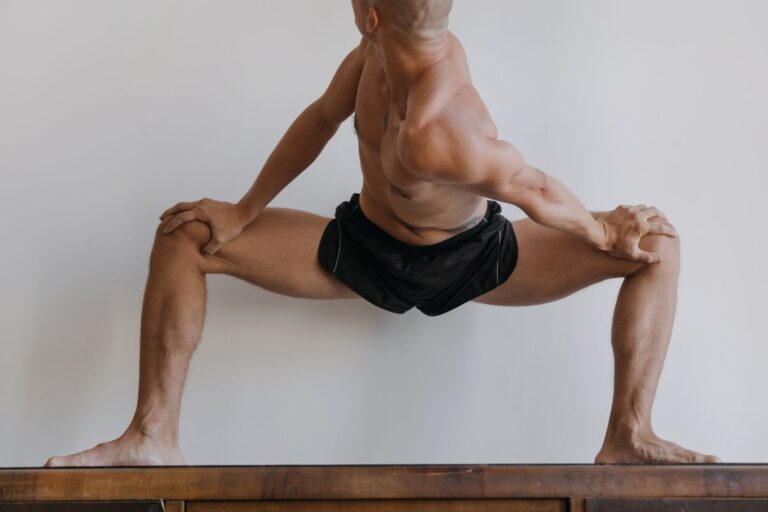
- Cossack squats: Wide stance, shift side to side into a deep lateral squat.
- Tibialis raises: Standing with heels against a wall, lift the toes repeatedly to strengthen the front of the shin.
How to Add Mobility Training to Your Current Workout Routine
You don’t need a separate mobility day. Fold it in intelligently:
- Pre-workout (5–10 min): Dynamic mobility that primes the joints you’re about to load — hip and ankle work before squats, thoracic and shoulder work before pressing.
- Between sets: Slot short mobility drills into rest periods instead of scrolling your phone.
- Post-workout (5–10 min): Slower, breath-driven flows to downshift the nervous system and improve recovery.
- Standalone sessions: One or two dedicated 20–30 minute sessions per week, ideally in a class setting like Vinyasa flow where you get instruction and accountability.
Who Benefits Most from Mobility Training?
Desk Workers and Sedentary Individuals
Eight hours of sitting shortens hip flexors, weakens glutes, and locks the upper back. Desk workers often feel results fastest because their baseline is so restricted — even 10 minutes a day of hip and thoracic work can transform how they feel by week two.
Athletes and Active Gym-Goers
For grapplers, strikers, lifters, and runners, mobility unlocks positions that translate directly into performance. A jiu-jitsu practitioner with mobile hips plays a completely different game. See more in what is yoga for athletes.
Older Adults and Those in Rehabilitation
Low-impact, joint-friendly, and infinitely scalable, mobility work is one of the safest and most effective interventions for adults over 50 and anyone returning from injury. It rebuilds capacity without punishing tissues that are still healing.
Frequently Asked Questions About Mobility Training Benefits
What are the main benefits of mobility training?
Better joint health, larger and more usable range of motion, reduced injury risk, improved posture, less chronic pain, better balance, faster recovery, sharper athletic performance, and greater independence as you age. Mental health gains — reduced stress and a stronger mind-body connection — are consistent bonuses.
How long does it take to see results from mobility training?
Most people notice reduced stiffness within one to two weeks and measurable range-of-motion improvements in four to six weeks, provided they practice consistently at least three times a week.
Is mobility training good for people with joint pain or arthritis?
Generally yes — controlled, pain-free range of motion is one of the most recommended interventions for arthritic joints because it circulates synovial fluid and preserves cartilage. Always work with a qualified coach or medical provider to modify around your specific condition.
Can mobility training replace stretching?
For most people, yes. Mobility work includes and improves on what static stretching delivers because it develops strength and control within that range, not just passive length.
Should I do mobility training before or after a workout?
Both. Use dynamic, joint-specific mobility as a warm-up to prime movement patterns, and slower, breath-driven mobility afterward to promote recovery and downregulate the nervous system.
Is daily mobility training safe for beginners?
Yes — short daily sessions (5–15 minutes) at low intensity are typically safer and more effective than infrequent long ones. Start conservatively, respect pain signals, and progress gradually.
Does mobility training help with weight loss or cardiovascular health?
Mobility work isn’t primarily a calorie-burning or cardio tool, but it makes the workouts that do drive those outcomes — strength training, striking, grappling, running — safer and more effective by improving movement quality. Indirectly, it’s a major contributor to a sustainable, injury-free training life.